Notebook entry
2026.08.26 / RECONSTITUTI
Reconstitution Math: From Vial Label to an Accurate Volume
- Field
- Research
- Logged
- 26 August 2026
- Reading time
- 8 min read
- References
- 2
- Source language
- EN
- Identifier
- TPL.2026.7361
01
Summary
Most dosing error in peptide work is arithmetic, not chemistry. How diluent volume, syringe units and net peptide content interact — and the three places the calculation usually breaks.
02
Methods
Desk review: published literature, manufacturer documentation and analytical certificates are read side by side. Claims without a traceable reference are marked as open questions, not conclusions.
03
Results
The hard part of working with lyophilised peptides in a laboratory setting is rarely the chemistry. It is the arithmetic, performed once, at a bench, from a label that was never designed to make it easy.
This piece walks the calculation end to end, then looks at the three places it reliably goes wrong.
The base equation
Everything follows from one relationship:
Concentration = mass of peptide ÷ volume of diluent
Add 2 mL of bacteriostatic water to a vial containing 10 mg of peptide and you have 5 mg/mL, or 5000 µg per mL. Nothing else in the process is more complicated than this; everything else is unit conversion.
Insulin syringe units are volume, not dose
A U-100 insulin syringe is graduated in units of insulin, which is a volume convention: 100 units = 1 mL, so 1 unit = 0.01 mL. The marking says nothing about the peptide in the barrel.
Continuing the example above at 5000 µg/mL:
- 1 unit = 0.01 mL = 50 µg
- 10 units = 0.10 mL = 500 µg
- 20 units = 0.20 mL = 1 mg
The useful habit is to write the µg-per-unit figure on the vial in marker the moment it is reconstituted. Every later measurement then becomes a division you already did.
Choosing the diluent volume deliberately
The volume is a free choice, and it should be chosen so the target measurement lands in the readable middle of the syringe. A measurement of 2 units carries the full error of the graduation; the same amount measured as 20 units does not.
| Vial | Diluent | Concentration | 500 µg equals |
|---|---|---|---|
| 5 mg | 1 mL | 5000 µg/mL | 10 units |
| 5 mg | 2 mL | 2500 µg/mL | 20 units |
| 10 mg | 2 mL | 5000 µg/mL | 10 units |
| 10 mg | 5 mL | 2000 µg/mL | 25 units |
More diluent means better resolution and a shorter usable life once the vial is open. Less diluent means a longer-lived vial and coarser measurement. That is the whole trade-off.
Break point 1: the label weight is nominal
A "10 mg" vial is a fill target, and the certificate of analysis usually reports a net peptide content well below 100% — commonly 75–85% for a TFA salt. At 80% content, that vial holds 8 mg of peptide and the true concentration after 2 mL is 4000 µg/mL, not 5000.
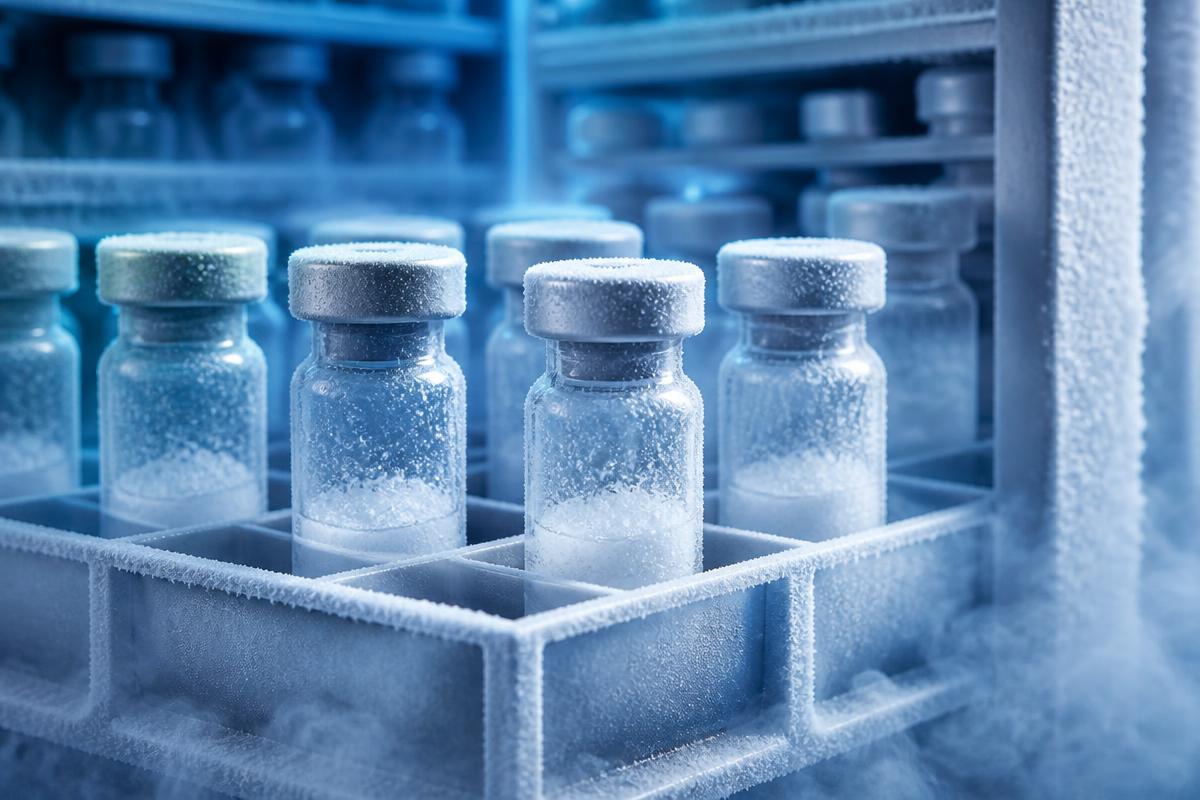
Whether to correct for this depends on the work. For comparative laboratory work where the same batch is used throughout, the nominal figure is internally consistent. For anything where absolute mass matters, use the content-corrected number and record which convention you used. That correction is only possible when the vendor publishes a per-batch content value: product pages such as Retatrutide 10 mg with per-lot certificate of analysis or BPC-157 10 mg batch-tested research peptide state the nominal mass and the analytical content separately, which is exactly what the calculation needs.
Break point 2: dead space and residual volume
Every syringe and needle retains liquid that is never delivered. In a standard (non low-dead-space) insulin syringe, this is on the order of 0.02–0.07 mL depending on the hub design. At 0.01 mL per unit, that is several units' worth of material lost per draw.
For a 20-unit measurement the effect is a rounding error. For a 3-unit measurement it is a substantial fraction of the intended amount. This is a second argument for diluting so that measurements sit high on the barrel.
Break point 3: reconstituting too fast
Peptides are surface-active and shear-sensitive. Injecting diluent hard against the powder cake and then shaking is the standard way to generate foam, and foam is an air–liquid interface where peptide unfolds and aggregates.
The alternative takes thirty seconds longer: run the diluent slowly down the inner wall of the vial, let the cake dissolve on its own, and roll the vial gently between the fingers if anything remains. A properly reconstituted solution is clear and free of visible particulates. A cloudy or stringy solution is not a mixing problem to be solved with more agitation.
Worked example
Target: 250 µg per measurement. Vial: 5 mg nominal, 82% net peptide content.
- Actual peptide: 5 mg × 0.82 = 4.1 mg = 4100 µg.
- Add 2 mL diluent → 2050 µg/mL → 20.5 µg per unit.
- 250 µg ÷ 20.5 = 12.2 units — round to 12, and record the rounding.
- Vial yields 4100 ÷ 250 = 16 measurements, minus dead-space losses.
Write steps 2 and 3 on the vial. The most reliable protection against a dosing error is not doing the calculation twice — it is only doing it once, in a place you cannot lose.
04
Sources
05
Cite this entry
- Identifier
- TPL.2026.7361
The Peptide Lens Desk. (2026). Reconstitution Math: From Vial Label to an Accurate Volume. The Peptide Lens. /journal/reconstitution-math
DOI registration pending — cite the identifier and canonical URL. Indexed for Google Scholar via Highwire Press, Dublin Core and PRISM metadata.
PubMed / MEDLINE record and NLM JATS full-text XML are available for harvesting; PubMed listing itself requires an ISSN and NLM acceptance.
Continue reading

Research · 11 min read
BPC-157: What the Preclinical Evidence Shows and Why No Human Trial Data Exists
Research · 12 min read
Growth Hormone Secretagogues: One Approved Drug, Several Research Compounds, and the Difference
Research · 10 min read