Notebook entry
2026.08.31 / EVALUATING-M
Evaluating Mod GRF 1-29 (CJC-1295 Without DAC): Secretagogue Kinetics, Receptor Dynamics, and Experimental Limitations
- Field
- Research
- Logged
- 31 August 2026
- Reading time
- 5 min read
- References
- 1
- Source language
- EN
- Identifier
- TPL.2026.9447
01
Summary
An editorial review examining the short-acting GHRH analog Mod GRF 1-29 (CJC-1295 no DAC), its physiological mechanism, pulsatile release profiles, and comparative distinction from long-acting formulations.
02
Methods
Desk review: published literature, manufacturer documentation and analytical certificates are read side by side. Claims without a traceable reference are marked as open questions, not conclusions.
03
Results
Introduction: Reassessing GHRH Analogues in Endocrine Research
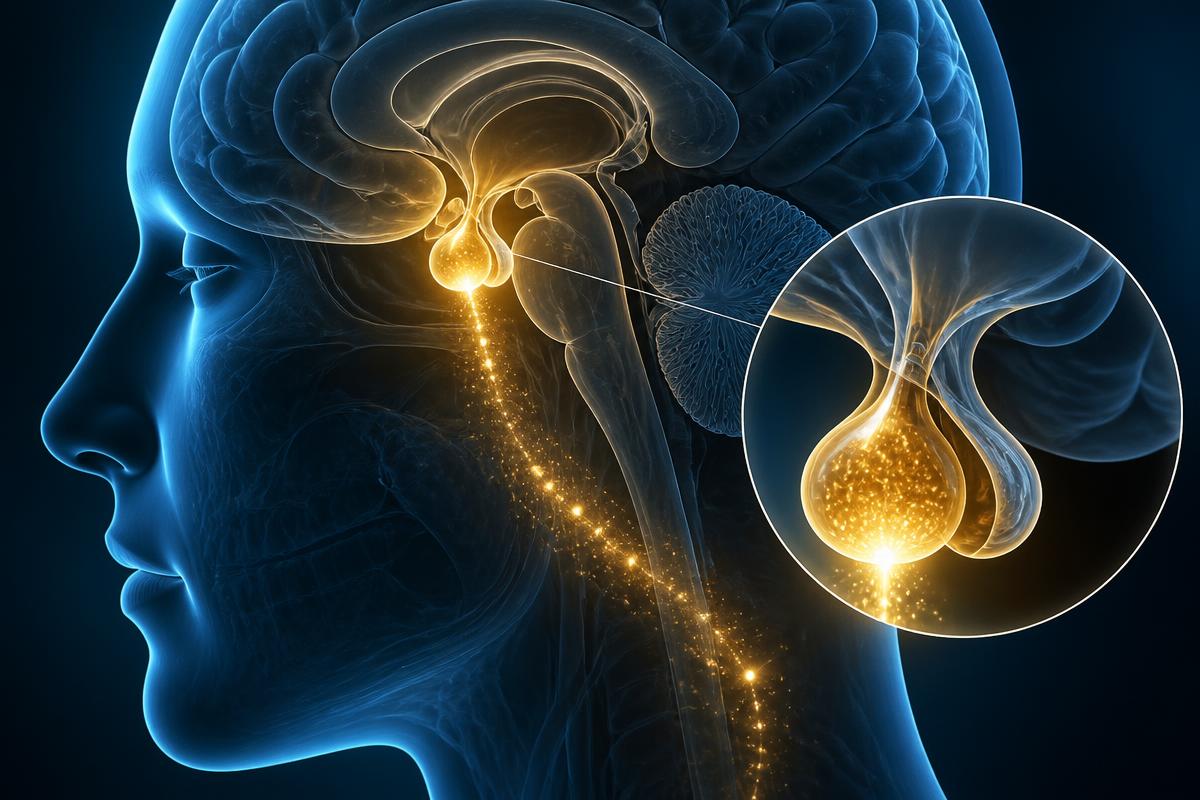
Growth hormone-releasing hormone (GHRH) and its synthetic derivatives have long occupied a central position in pituitary physiology studies. The endogenous 44-amino-acid peptide GHRH is responsible for stimulating the synthesis and pulsatile secretion of growth hormone (GH) from anterior pituitary somatotrophs. However, native GHRH exhibits a remarkably short biological half-life in circulation—typically under ten minutes—due to rapid enzymatic cleavage by dipeptidyl peptidase IV (DPP-IV) and renal clearance. To establish viable laboratory tools for studying neuroendocrine pathways, synthetic analogues were developed to improve enzymatic stability while preserving receptor affinity.
Among these compounds, CJC-1295 without DAC—more accurately designated in formal biochemical literature as Modified GRF 1-29 (Mod GRF 1-29)—represents a specific structural modification of the N-terminal 29-amino-acid sequence of human GHRH. By substituting four specific amino acids, researchers produced a peptide resistant to rapid DPP-IV degradation while maintaining a short, physiological half-life. Understanding the distinction between this short-acting peptide and its long-acting conjugated variant (CJC-1295 with DAC) is crucial for interpretative precision in peptide research.
Structural Modifications: Mod GRF 1-29 versus CJC-1295 with DAC
The nomenclature surrounding CJC-1295 frequently introduces confusion in empirical literature. The base molecule, GRF 1-29 (sermorelin), contains the minimum functional peptide sequence required to activate the GHRH receptor. To enhance metabolic stability without dramatically altering clearance mechanics, scientists introduced four amino acid substitutions: D-Ala at position 2, Gln at position 8, Ala at position 15, and Leu at position 27. This modified tetrasubstituted peptide is properly termed Mod GRF 1-29.
When the Drug Affinity Complex (DAC) is chemically attached to Mod GRF 1-29, the molecule gains the ability to covalently bind to circulating serum albumin. This conjugation fundamentally alters its pharmacokinetics:
- CJC-1295 with DAC: Possesses an extended terminal half-life of approximately 6 to 8 days. It creates continuous, tonic elevation of circulating growth hormone and downstream insulin-like growth factor 1 (IGF-1).
- CJC-1295 without DAC (Mod GRF 1-29): Retains a rapid clearance profile with an estimated half-life of 30 minutes. It induces a discrete, transient peak in serum GH, mimicking the natural episodic pulses characteristic of physiological secretion.
Receptor Dynamics and Intracellular Signaling
Mod GRF 1-29 functions as a selective agonist at the GHRH receptor, a G-protein-coupled receptor (GPCR) predominantly expressed on the cell surface of somatotrophs in the anterior pituitary. Upon ligand binding, the receptor undergoes a conformational change that activates the Gs alpha subunit, stimulating transmembrane adenylyl cyclase.
This enzymatic activation drives the conversion of adenosine triphosphate (ATP) to cyclic adenosine monophosphate (cAMP), subsequently activating protein kinase A (PKA). The resulting phosphorylation cascade triggers both the opening of voltage-gated calcium channels—facilitating exocytosis of pre-stored GH vesicles—and the activation of CREB transcription factors, which promote GH1 gene transcription. Crucially, because Mod GRF 1-29 clears rapidly, it does not induce continuous GHRH receptor occupancy, thereby preserving normal receptor recycling and avoiding prolonged desensitization.
Mechanistic Rationale for Dual Secretagogue Co-Administration
In experimental settings, GHRH agonists like Mod GRF 1-29 are frequently paired with growth hormone secretagogues (GHSs), particularly selective ghrelin receptor (GHS-R1a) agonists such as ipamorelin. The neuroendocrine basis for this combination relies on signal transduction convergence and functional synergy:
| Target Pathway | Mod GRF 1-29 (GHRH Analog) | Ipamorelin (GHS-R1a Agonist) |
|---|---|---|
| Primary Receptor | GHRH Receptor (Gs-coupled) | GHS-R1a (Gq-coupled) |
| Intracellular Messenger | cAMP / Protein Kinase A | Phospholipase C / IP3 / Calcium |
| Somatostatin Modulation | Stimulates synthesis/release dependent on tone | Inhibits somatostatin release and blunts its action |
| GH Release Pattern | Increases amplitude of pulse | Triggers release and attenuates feedback inhibition |
Co-administration results in a non-linear, synergistic amplification of GH release. While Mod GRF 1-29 provides the primary signal for transcript synthesis and release, the GHS-R1a agonist acts simultaneously to suppress hypothalamic somatostatin (growth hormone-inhibiting hormone) tone and mobilize intracellular calcium pools. This dual action yields a pronounced secretagogue response without requiring excessive concentrations of either individual compound.
Observational Risks and Pharmacological Considerations
While Mod GRF 1-29 offers a controlled kinetic profile, preclinical models and theoretical literature highlight several safety considerations and physiological parameters that mandate cautious evaluation:
- Glycemic Impact: Sustained or repeated GH pulses promote lipolysis and gluconeogenesis while antagonizing peripheral insulin action, potentially inducing transient hyperglycemia or altering insulin sensitivity.
- Water Retention and Hemodynamic Effects: GH and IGF-1 elevations can promote renal sodium reabsorption, leading to mild extracellular fluid retention, transient peripheral edema, or minor blood pressure fluctuations.
- Pituitary Axis Integrity: Excessive administration frequency risks exhausting intracellular GH pools or disrupting the endogenous hypothalamic-pituitary axis via feedback loops involving IGF-1 and somatostatin.
- Off-Target Selectivity: Unlike earlier non-selective GHRH/GHRP compounds, pure Mod GRF 1-29 displays high receptor selectivity, exhibiting minimal affinity for corticotropin-releasing or prolactin-releasing pathways when purified to analytical standards.
Conclusion and Outlook for In Vitro and Animal Models
CJC-1295 without DAC (Mod GRF 1-29) remains an invaluable reference tool for investigating pulsatile endocrine kinetics and pituitary somatotroph responsiveness. Its short half-life closely approximates physiological signaling mechanisms, distinguishing it from long-acting continuous agonists that risk downregulating target receptors. Researchers evaluating secretagogue protocols must prioritize rigorous batch verification and precise kinetic control to isolate specific biochemical outcomes.
Sourcing note: laboratories comparing batch documentation can review research peptides with batch certificates of analysis for reference material.
04
Sources
- [01]Cjc1296 No Dac
05
Cite this entry
- Identifier
- TPL.2026.9447
The Peptide Lens Desk. (2026). Evaluating Mod GRF 1-29 (CJC-1295 Without DAC): Secretagogue Kinetics, Receptor Dynamics, and Experimental Limitations. The Peptide Lens. /journal/evaluating-mod-grf-1-29-cjc-1295-without-dac-secretagogue-kinetics-rec
DOI registration pending — cite the identifier and canonical URL. Indexed for Google Scholar via Highwire Press, Dublin Core and PRISM metadata.
PubMed / MEDLINE record and NLM JATS full-text XML are available for harvesting; PubMed listing itself requires an ISSN and NLM acceptance.
Continue reading

Research · 11 min read
BPC-157: What the Preclinical Evidence Shows and Why No Human Trial Data Exists
Research · 12 min read
Growth Hormone Secretagogues: One Approved Drug, Several Research Compounds, and the Difference
Research · 10 min read