Notebook entry
2026.08.24 / COLD-CHAIN-A
Cold Chain, Freeze-Thaw and What Actually Degrades a Peptide
- Field
- Research
- Logged
- 24 August 2026
- Reading time
- 10 min read
- References
- 3
- Source language
- EN
- Identifier
- TPL.2026.7295
01
Summary
Lyophilised peptides are more robust than the shipping rhetoric suggests, and reconstituted ones are more fragile. What the degradation chemistry says about transport, storage and the freezer door.
02
Methods
Desk review: published literature, manufacturer documentation and analytical certificates are read side by side. Claims without a traceable reference are marked as open questions, not conclusions.
03
Results
Cold chain is the part of peptide logistics that generates the most anxiety and the least analysis. A parcel arrives with a soft ice pack and the material is written off; another sits at room temperature for a week and nobody thinks about it. Both reactions come from the same place: treating "cold" as the property that matters, rather than asking what the degradation reactions actually need in order to run.
Water is the variable, not temperature
The main routes by which a peptide falls apart in storage are chemical, and most of them require mobile water:
- Hydrolysis of the peptide backbone, most readily at Asp-Pro and Asp-Gly bonds.
- Deamidation of asparagine and glutamine residues, which proceeds through a cyclic imide intermediate and is strongly pH- and water-dependent.
- Oxidation of methionine, cysteine and tryptophan, driven by dissolved oxygen and trace metals.
- Aggregation, which is physical rather than covalent and is accelerated at interfaces — air–liquid, liquid–glass, and the ice front during freezing.
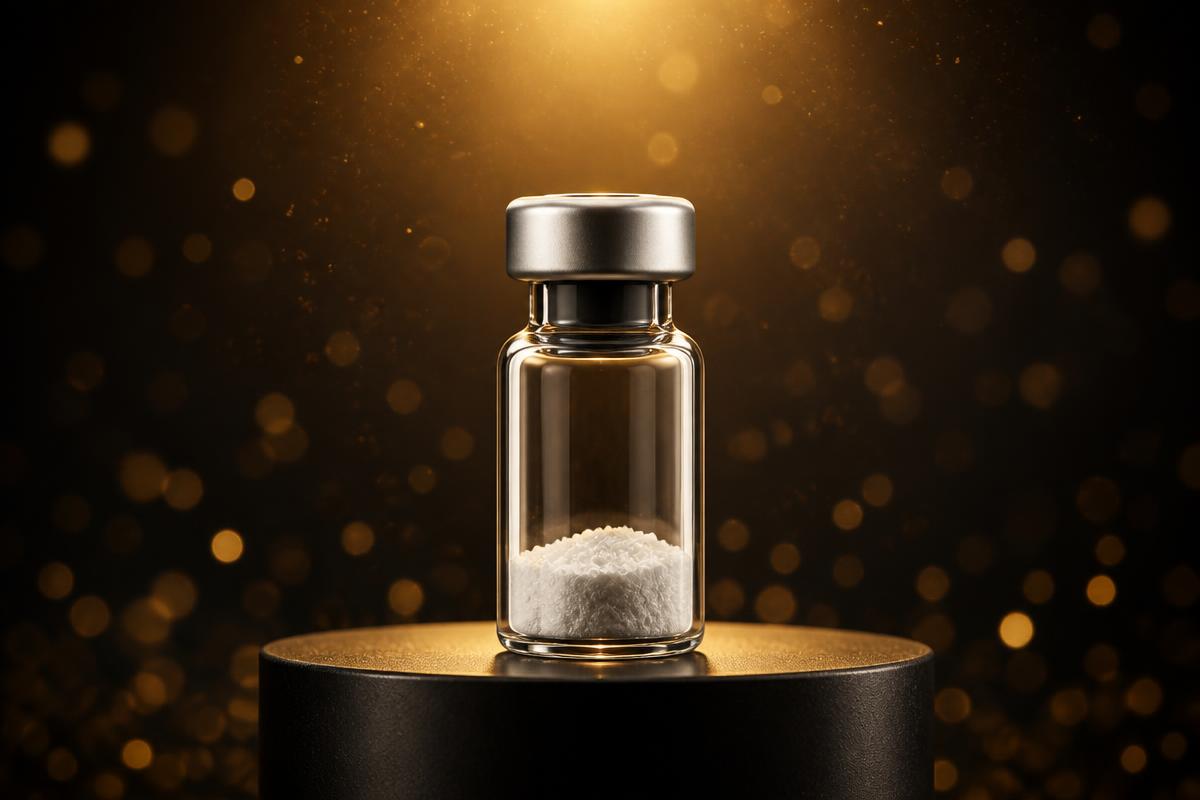
Lyophilisation removes the solvent that most of these reactions run in. That is the entire reason peptides are shipped as a powder cake: a properly dried, sealed, low-residual-moisture vial has very little chemistry available to it, even at ambient temperature.
A lyophilised peptide is not fragile because it is cold-stored. It is cold-stored because that is the cheapest way to add margin to something already stable.
What transit temperature actually does
Stability testing under ICH conditions routinely exposes lyophilised material to 25 °C/60% RH for months, and accelerated conditions of 40 °C for weeks, precisely to establish that short excursions are tolerable. A few days in a warm van is, for most sealed lyophilised peptides, within the excursion envelope that stability programmes are designed to cover.
Two caveats keep this from being a blanket reassurance. First, it depends on the residual moisture in the vial — which is why the Karl Fischer figure on a certificate of analysis is worth more than it looks. Second, an excursion is only harmless if it is bounded and known: a package that spent three days at 45 °C in direct sun is a different object from one that spent three days at 22 °C.
The practical ask of a supplier is not "was it shipped frozen" but "what was it exposed to, and what does the stability data cover". Vendors publishing storage and stability documentation per product let that question be answered from a document rather than a chat reply. Lyophilised listings such as GHK-Cu 100 mg lyophilised research peptide or TB-500 10 mg with storage and COA documentation state the storage condition alongside the batch report, so the shipping question becomes checkable instead of rhetorical.
After reconstitution, the rules invert
The moment diluent enters the vial, every reaction listed above has its solvent back. A reconstituted peptide is a genuinely time-limited material, and the relevant factors are:
- Temperature. Refrigeration at 2–8 °C slows hydrolysis and deamidation substantially compared with room temperature.
- Light. Tryptophan and tyrosine are photosensitive; an amber vial or a closed drawer is free protection.
- Preservative. Bacteriostatic water containing benzyl alcohol limits microbial growth; plain sterile water does not, which shortens usable life sharply.
- Headspace and agitation. Every shake reintroduces the air–liquid interface where aggregation starts.
Freeze-thaw: the one that is genuinely damaging
Freezing a reconstituted solution is not neutral. As ice forms, solutes concentrate in the shrinking liquid phase, local pH can shift by more than a unit as buffer components crystallise out at different rates, and the growing ice front is a large interface for adsorption and unfolding. Each cycle contributes.
Two consequences follow directly:
- Aliquot before freezing. Single-use volumes remove the need for repeat cycles entirely.
- Do not store working vials in the freezer door. The door is the warmest, most thermally cycled position in the appliance — every opening is a partial thaw.
A workable storage table
| State | Storage | Notes |
|---|---|---|
| Lyophilised, sealed | −20 °C long term; 2–8 °C routine | Ambient excursions in transit are usually tolerated |
| Lyophilised, opened | 2–8 °C, desiccated | Moisture ingress is the risk, not warmth |
| Reconstituted, bacteriostatic | 2–8 °C, dark | Time-limited; label the reconstitution date |
| Reconstituted, aliquoted | −20 °C, single use | Thaw once, slowly, at 2–8 °C |
What visual inspection can and cannot tell you
Cloudiness, visible particulates, discolouration or a solution that will not clear are all reasons to discard. But the absence of those signs is weak evidence: deamidation and oxidation produce no visual change whatsoever, and a partially degraded solution looks exactly like a fresh one.
Which is the honest conclusion of the whole topic. Storage discipline is not a way of confirming that material is intact — it is the only lever available, because by the time a peptide looks wrong, the interesting degradation happened weeks earlier and left no trace you could see.
04
Sources
05
Cite this entry
- Identifier
- TPL.2026.7295
The Peptide Lens Desk. (2026). Cold Chain, Freeze-Thaw and What Actually Degrades a Peptide. The Peptide Lens. /journal/cold-chain-and-peptide-stability
DOI registration pending — cite the identifier and canonical URL. Indexed for Google Scholar via Highwire Press, Dublin Core and PRISM metadata.
PubMed / MEDLINE record and NLM JATS full-text XML are available for harvesting; PubMed listing itself requires an ISSN and NLM acceptance.
Continue reading
Research · 11 min read
BPC-157: What the Preclinical Evidence Shows and Why No Human Trial Data Exists
Research · 12 min read
Growth Hormone Secretagogues: One Approved Drug, Several Research Compounds, and the Difference
Research · 10 min read